Skip to content

There are 144 inches in 4 yards. That’s the quick answer, but if you’re buying fabric, measuring a room or finishing homework, you probably want a bit more. This guide covers the math, a few mental tricks, some handy charts and a few practice questions.
Quick Answer: 4 Yards in Inches
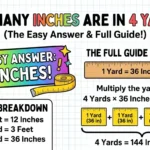
4 yards = 144 inches
That’s the same as 12 feet, or about 3.66 meters.
Quick Answers to Common Questions
Is 4 yards equal to 144 inches? Yes. One yard is 36 inches, and 4 × 36 = 144.
Is 4 yards 12 feet? Yes. One yard is 3 feet, so 4 yards is 12 feet.
Does 1 yard equal 12 inches? No. One foot is 12 inches. One yard is 36 inches.
How Many Inches Are in a Yard?

There are 36 inches in a yard, and every yards-to-inches problem starts from that number. A yard has 3 feet and each foot has 12 inches, so 3 × 12 = 36.
Why Is 4 Yards 144 Inches?
Because one yard is 36 inches, you multiply 4 by 36.
4 × 36 = 144
The Yards to Inches Formula
The same formula works for any number of yards:
Inches = Yards × 36
- 1 yard × 36 = 36 inches
- 2 yards × 36 = 72 inches
- 3 yards × 36 = 108 inches
- 4 yards × 36 = 144 inches
- 5 yards × 36 = 180 inches
Every extra yard adds 36 inches.
How to Convert 4 Yards to Inches Step by Step
- Write down the number of yards. Here it’s 4.
- Remember that 1 yard equals 36 inches.
- Multiply 4 by 36. The answer is 144 inches.
To do it in your head, split the multiplication: 4 × 30 is 120, 4 × 6 is 24, and 120 + 24 = 144.
A Second Way to Get the Answer
You can also go through feet. Four yards is 4 × 3 = 12 feet, and 12 feet × 12 inches = 144 inches. Both routes land on the same number, which makes this a good way to check your work.
What Is a Yard?
A yard is a unit of length equal to 3 feet or 36 inches. It belongs to the US customary and imperial systems and is written as yd, so 4 yards is 4 yd. Since 1959, one international yard has been defined as exactly 0.9144 meters, which ties it to the metric system.
What Is an Inch?
An inch is one twelfth of a foot, or one thirty-sixth of a yard. It’s written as in or with the double-prime mark (″), so 144 inches can be written 144 in or 144″. One inch equals exactly 2.54 centimeters.
To picture one inch, think of a US quarter. It’s about 0.955 inches across, just under an inch.
How Many Feet Are in 4 Yards?
4 yards is 12 feet (4 × 3). For comparison, a basketball hoop sits at 10 feet, so 12 feet is two feet higher than that.
How Many Inches Are in 3 Yards?
There are 108 inches in 3 yards (3 × 36). A shortcut: take 4 yards (144 inches) and subtract one yard (36 inches) to get 108.
Converting 4 Yards to Metric
How Many Centimeters Are in 4 Yards?
Multiply 144 inches by 2.54:
144 × 2.54 = 365.76 centimeters, or about 366 cm.
How Many Meters Are in 4 Yards?
One yard is 0.9144 meters, so:
4 × 0.9144 = 3.6576 meters, or about 3.66 m.
How Many Yards Are in 4 Meters?
Going the other way matters if you buy fabric in a country that sells it by the meter. One meter is about 1.0936 yards, so:
4 × 1.0936 = 4.3744 yards, or about 157.5 inches.
So 4 meters is longer than 4 yards, by about 13.5 inches. If a pattern asks for 4 yards and you buy 4 meters, you’ll have extra cloth. If it asks for 4 meters and you buy 4 yards, you’ll come up short.
Yards to Inches Chart (1 to 20 Yards)
| Yards | Inches |
|---|---|
| 1 | 36 |
| 2 | 72 |
| 3 | 108 |
| 4 | 144 |
| 5 | 180 |
| 6 | 216 |
| 7 | 252 |
| 8 | 288 |
| 9 | 324 |
| 10 | 360 |
| 11 | 396 |
| 12 | 432 |
| 13 | 468 |
| 14 | 504 |
| 15 | 540 |
| 16 | 576 |
| 17 | 612 |
| 18 | 648 |
| 19 | 684 |
| 20 | 720 |
Save or print this table. It’s useful for sewing, crafts and home projects.
Part Yards: Fractions Made Simple
When you have a fraction like 4 1/2 or 3 1/4 yards, the same rule applies. Convert the whole yards, convert the fraction, and add them.
- 4 1/2 yards: 144 + 18 = 162 inches
- 4 3/4 yards: 144 + 27 = 171 inches
- 3 1/4 yards: 108 + 9 = 117 inches
- 2 3/4 yards: 72 + 27 = 99 inches
- 1 1/4 yards: 36 + 9 = 45 inches
- 5 3/4 yards: 180 + 27 = 207 inches
If you meant just 1/4 yard, that’s 9 inches.
Small Yard Fractions Chart
Fabric shops often cut in smaller parts of a yard.
| Part of a Yard | Inches |
|---|---|
| 1/8 yard | 4.5 (about 5) |
| 1/4 yard | 9 |
| 1/3 yard | 12 |
| 3/8 yard | 13.5 (about 14) |
| 1/2 yard | 18 |
| 5/8 yard | 22.5 (about 23) |
| 2/3 yard | 24 |
| 3/4 yard | 27 |
| 7/8 yard | 31.5 (about 32) |
| 1 yard | 36 |
Shops usually round the half-inch values up so you don’t end up short.
Numbers Close to 4 Yards
| Yards | Inches |
|---|---|
| 4 | 144 |
| 4 1/8 | 149 |
| 4 1/4 | 153 |
| 4 1/3 | 156 |
| 4 3/8 | 158 |
| 4 1/2 | 162 |
| 4 5/8 | 167 |
| 4 2/3 | 168 |
| 4 3/4 | 171 |
| 4 7/8 | 176 |
| 5 | 180 |
Mixing Yards and Feet

Say you have 4 yards and 2 feet. Four yards is 144 inches, two feet is 24 inches, and 144 + 24 = 168 inches.
Adding yards, feet and inches by hand gets messy fast, so an inch fraction calculator is worth using when you have several mixed lengths to add.
What About 4 Feet 6 Inches?
People sometimes search “how many inches is 4 6”, which usually means 4 feet 6 inches. Four feet is 48 inches, plus 6 more gives 54 inches. That’s not the same as 4 yards, and mixing up feet and yards is one of the most common slip-ups, so check your units.
How Long Is 4 Yards of Fabric?
Four yards of fabric is 144 inches long, which is 12 feet or about 3.66 meters. That’s longer than most doors are tall.
Fabric also has a width, and that matters just as much. Most fabric is between 44 and 60 inches wide, so your 4 yards could be 45 inches wide or 60. With 4 yards you could make a simple dress, a pair of curtains, a small quilt top, a few tote bags or a tablecloth.
How Width Changes Your Fabric
Take two bolts that are both 4 yards long:
- At 45 inches wide: 144 × 45 = 6,480 square inches (45 square feet)
- At 60 inches wide: 144 × 60 = 8,640 square inches (60 square feet)
Same length, but a third more cloth. That’s why wider fabric often means you can buy fewer yards.
How Fabric Shops Sell by the Inch
Fabric comes on a bolt, which is a large roll of cloth. Some shops cut bolt fabric by the inch, so if you need 4 yards you can ask for 144 inches. Some set a minimum cut, such as 4 inches, so check your shop’s rules. Notions like ribbon and trim are often sold by length too, which makes inch math handy.
A Simple Fabric Yardage Guide
| Project | Rough Yards Needed |
|---|---|
| Pillow cover | 1/2 to 1 |
| Tote bag | 1/2 to 1 |
| Tablecloth (medium table) | 2 to 3 |
| Simple dress | 2 to 4 |
| Lap quilt backing | 3 to 4 |
| Pair of curtains | 3 to 6 |
These are estimates. Your pattern will list exact yardage for each fabric width.
Tips for Buying Fabric
- Buy a little extra, since fabric can shrink in the wash.
- Check the pattern guide for the yardage it recommends.
- Round fractions up, not down.
- Measure twice and cut once.
- Ask the clerk for a straight edge when you need a clean cut.
How Big Is 4 Yards in Real Life?
Four yards is 144 inches, or 12 feet. Stood on end, that’s about the height of a high ceiling and nearly twice a standard door (about 6.7 feet). Laid flat, it’s roughly two sofas end to end, or close to the length of a recreational kayak.
Real-Life Uses for 4 Yards
Sewing and crafts. Fabric stores sell by the yard, and 4 yards is a common amount for quilts, curtains and clothing.
Ribbon, rope, yarn and hose. Many items are sold by the yard or the foot. Four yards of ribbon or yarn is 144 inches, and four yards of rope or garden hose is 12 feet.
Home projects. Hanging a banner or wrapping a large gift often calls for a few yards of ribbon or cord, and knowing the inch count helps you plan each cut.
Construction. Plans may list a wall in feet while a supply list gives cable in yards, so switching between units quickly saves time and waste.
School. Converting yards to inches is a standard skill in math and STEM classes.
A Short History of the Yard and the Inch
The yard began as a loose, body-based measure. It was often described as the distance from the nose to the thumb, or the length of a belt or stride, before it was fixed as a standard length. In 1959 the United States and other countries agreed that one yard equals exactly 0.9144 meters. The notice was published by the National Bureau of Standards, now called NIST.
The word inch comes from the Latin uncia, meaning one twelfth, since there are 12 inches in a foot. The same 1959 agreement set one inch at exactly 2.54 centimeters. NIST still uses these values, including in Handbook 133, its guide for checking the net contents of packaged goods.
Imperial vs. Metric Systems
The yard and inch belong to the US customary and imperial systems, which the United States uses every day. Most of the world uses the SI metric system, with meters and centimeters.
| Imperial | Metric |
|---|---|
| 1 inch | 2.54 cm |
| 1 foot | 30.48 cm |
| 1 yard | 91.44 cm |
| 4 yards | 365.76 cm |
If you travel or shop online, you may need both.
Yard, Square Yard, and Cubic Yard
The word “yard” can mean three different things. A yard measures length, a square yard measures flat area, and a cubic yard measures volume.
Square Yards
A square yard is 3 feet by 3 feet, so it’s 9 square feet, or 1,296 square inches. Carpet is often sold this way. A room that is 12 feet by 9 feet is 108 square feet, and dividing by 9 gives 12 square yards.
Cubic Yards
A cubic yard is 3 feet by 3 feet by 3 feet, which is 27 cubic feet or 46,656 cubic inches. Soil, mulch and gravel are usually sold this way. As a rough guide, one cubic yard covers about 108 square feet at a depth of 3 inches.
Why This Matters for 4 Yards
Four yards of length is 144 inches, but 4 square yards is 36 square feet and 4 cubic yards is 108 cubic feet. Always check which unit a label or shop means.
Related Conversions for 4 Yards
| Unit | Value for 4 Yards |
|---|---|
| Inches | 144 |
| Feet | 12 |
| Centimeters | 365.76 |
| Millimeters | 3,657.6 |
| Meters | 3.6576 |
| Kilometers | 0.0036576 |
| Miles | 0.00227 (about) |
There are 1,760 yards in a mile, so 4 yards is a very small part of one.
How to Go Backwards: Inches to Yards

To turn inches into yards, divide by 36.
Yards = Inches ÷ 36
For example, 144 ÷ 36 = 4 yards, and 180 ÷ 36 = 5 yards. This is also a good way to check your work: convert to inches, then convert back and see if you land on the same number.
| Inches | Yards |
|---|---|
| 36 | 1 |
| 72 | 2 |
| 108 | 3 |
| 144 | 4 |
| 180 | 5 |
| 216 | 6 |
| 252 | 7 |
| 288 | 8 |
| 324 | 9 |
| 360 | 10 |
Common Mistakes to Avoid
- Mixing up yards and feet. One yard is 3 feet, and one foot is 12 inches.
- Using the wrong number. Using 12 instead of 36 gives 48 inches. The right answer is 144.
- Forgetting the unit. Write “inches” next to the number, because 144 alone doesn’t say much.
- Rounding too early. When converting to metric, keep the extra decimals until the end.
- Trusting a chart without checking. Some charts online have typos, such as showing 2 yards as 62 inches. The right value is 72, so check against the 36 rule.
- Mixing up yards and meters. Four meters is about 4.37 yards, so check which unit your pattern uses.
Handy Mental Math Tricks
- Think in feet first. Yards × 3 gives feet, and feet × 12 gives inches.
- Split the number. For 4 × 36, do 4 × 40 = 160, then subtract 4 × 4 = 16 to get 144.
- Double it. Two yards is 72 inches, so four yards is 72 + 72 = 144.
Tools That Make It Easy
Online converters, phone calculators (just multiply by 36) and voice assistants all do the job in seconds. A printed chart in your craft room or toolbox works too, and fraction calculators help when you’re adding yards, feet and inches together. Still, it’s worth knowing the math, because tools can fail and the 36 rule is easy to remember.
Tools for Measuring in Real Life
- Ruler: usually 12 inches, good for small jobs.
- Yardstick: 36 inches long, exactly one yard. You’d need four of them to reach 4 yards.
- Tape measure: most run from 6 to 35 feet and suit longer jobs.
- Cloth tape: soft and flexible, ideal for fabric and body measurements.
- Measuring wheel: rolls along the ground for long outdoor distances.
- Laser distance measurer: gives a quick reading across a room.
If you print a ruler from a website, print at full size and check it against a real ruler.
How to Read a Tape Measure
Each inch is divided into smaller parts, and the marks get shorter as the parts get smaller. The longest mark between inches is 1/2 inch, then 1/4 and 3/4, then 1/8, and the smallest marks are 1/16.
- Find the last whole inch before your line.
- Count the small marks past that inch.
- Add the whole inches and the fraction.
For example, 2 inches plus 5 marks of 1/8 inch each is 2 and 5/8 inches.
Measuring Tips for Best Results
- Use a flat, hard surface.
- Keep the tape straight and tight.
- Start from the zero mark, not the tip.
- Write the number down right away.
- Measure twice to be safe.
Practice Questions
- How many inches are in 5 yards?
- How many inches are in 6 yards?
- How many inches are in 7 yards?
- How many inches are in 2 1/2 yards?
- How many yards are in 288 inches?
Answers: 1) 180 inches. 2) 216 inches. 3) 252 inches. 4) 72 + 18 = 90 inches. 5) 288 ÷ 36 = 8 yards.
FAQ
144 inches.
12 feet.
108 inches.
36 inches.
365.76 cm, or 3.6576 meters.
162 inches.
Final Thoughts
Four yards is 144 inches. Multiply 4 by 36, or go through feet and do 12 × 12, and you get the same result either way. With the charts, the fraction tables and a few mental tricks above, you should be able to handle part yards, fabric lengths and metric conversions without reaching for a calculator.

Rachel Foster creates simple and practical measurement guides that help readers understand sizes, dimensions, and unit conversions. Her content focuses on making everyday measurements easier to visualize and compare through clear explanations and useful real-world examples.